
Life On A Hawaii Longline Fishing Vessel

Bringing Hawaii’s freshest seafood into the kitchens and onto the tables of our customers is a team effort. From the sales representatives upstairs to the processors in our shop downstairs, from our truck drivers to our marine mechanics, we all depend on one another to provide the best quality, service, and freshness in the industry. But of all the members of our team that drive this ocean-to-table process, it’s our captains and fishermen that play perhaps the most unusual and least understood role of all.
So what goes on out there aboard Hawaiian Fresh Seafood’s fishing boats? What’s it like to be a longline fisherman in Hawaii and who exactly is catching your fish? To find out, we brought a camera out with us on the F/V Cumberland Trail. We took some pictures and we took some notes. What follows is a Hawaii longline fishing trip in pictures:

Heading Out: By the time bait, ice, and groceries are loaded onboard it’s almost midnight. The crew pull mooring lines into the boat and captain Ben maneuvers out of the harbor.

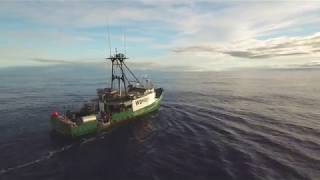
Under Way: Steaming out to the fishing grounds can take a few days and with easterly trade winds pushing the water towards the islands, it can get a little bumpy. We were lucky this trip and enjoyed unusually calm seas.

Wetting The Line: There’s a lot of water in the Pacific and finding the fish can be akin to finding the proverbial needle in a haystack. Captain Ben studies current, temperature, water structure, and bottom contours all of which inform his choice of where to fish on a given day.

Setting Gear: The Cumberland Trail usually sets about 35 miles of gear and nearly three thousand hooks. This is Will demonstrating how each hook is baited by hand and tossed into the water. During the trip crew members will take turns setting the gear so that they can get some extra sleep.

Slow and Steady: It take between five and six hours to get the gear into the water. When the last hook is baited and tossed over, a radio buoy is attached and the gear is left to “soak” for several hours. The crew have a midday meal and get some sleep until it's time to bring it in.

Evening Meal: As the crew get ready for hauling operations, they fill up on nourishment. A solid meal now is important since another opportunity to rest might not come until morning.

All Night Long: Depending on the weather, how much fish they’re catching, and other factors, hauling in the gear can take from 10 to 14 hours.

Bringing In The Gear: Everyone has a job to do on deck. Driving the boat, coiling the lines, gaffing fish, cleaning and icing the catch… There’s a lot to do and everyone settles into a routine fueled by music coming from the deck speakers.

Fish On: Once a fish is alongside the boat the crew carefully use gaffs to secure it and bring it on deck. A poorly placed gaff or any other mistake at this point can prove disastrous and result in the fish getting away. When a marker bigeye is at the door, everyone on deck comes together to make sure it ends up in the ice hold.


Processing: Once on board the work continues and each fish is bled, gilled, and gutted before being lowered to the ice hold.

Ice Hold: Each fish is individually packed in ice for the ride home. Larger fish that are still giving off body heat are packed and then repacked to ensure freshness.

Variety: Although bigeye tuna is the target species for our fishing trips, we still love to see non-target species like opah, aka moonfish. These fish add variety to our catch and our customers love it!

Dusk til' Dawn: When the fishing's good, the crew is just finishing the haul when the sun comes up. Despite long hours and grueling work, the crew are always happy when the catch is good.

Homeward Bound: After about two weeks of fishing, the F/V Cumberland Trail has a good load of fish and is headed home to offload the catch.

Home Sweet Home: As soon as the boat hits the dock, the crew is greeted by the rest of the Hawaiian Fresh Seafood Team who immediately begin offloading the catch. The fish will be processed and on its way to our customers within hours.





gavangtv.news Mình thử truy cập website này để xem qua cách thiết kế và tổ chức nội dung. Tổng thể trang tạo cảm giác khá chỉn chu, các phần được bố trí theo từng khu vực nên không bị rối khi lướt. Thanh menu và các danh mục được sắp xếp dễ hiểu, giúp mình nhanh chóng chuyển đến nội dung cần xem. Mình cũng mở thử bằng điện thoại thì giao diện vẫn tương đối cân đối, các nút chức năng dễ thao tác và việc cuộn trang khá thuận tiện. Sau khi xem qua một lượt, mình thấy website có cách trình bày rõ ràng, thao tác đơn giản và khá dễ sử dụng.
aiscore.id Saya menemukan website ini secara tidak sengaja dan mencoba melihat-lihat beberapa bagian di dalamnya. Secara keseluruhan, tampilannya cukup rapi dan terasa nyaman karena susunan halaman tidak terlalu padat. Menu utama juga dibuat sederhana sehingga saya bisa berpindah dari satu kategori ke kategori lain tanpa perlu banyak mencari. Informasi yang tersedia dikelompokkan dengan cukup jelas, jadi lebih mudah mengikuti isi setiap halaman. Saya juga mencobanya melalui ponsel dan tampilannya tetap menyesuaikan layar dengan baik, termasuk saat scrolling dan membuka menu. Setelah menjelajah beberapa bagian, menurut saya website ini cukup praktis, mudah dipahami, dan tidak membutuhkan waktu lama untuk membiasakan diri.
F168 Mình tình cờ tìm thấy website này và quyết định vào xem thử một vòng. Cảm giác đầu tiên là trang được sắp xếp khá gọn, phần nội dung chính nổi bật nhưng vẫn có đủ khoảng trống nên tổng thể nhìn dễ chịu. Các chuyên mục được phân loại tương đối rõ, muốn xem thêm phần khác chỉ cần thao tác vài bước là tới. Mình cũng thử mở một số trang bằng điện thoại và thấy giao diện thích ứng khá tốt, không gặp nhiều bất tiện trong lúc đọc hoặc chuyển mục. Sau khi trải nghiệm, mình đánh giá cao sự đơn giản trong cách thiết kế và khả năng giúp người dùng nhanh chóng tìm được…
Habang tumitingin ako sa iba pang online platforms, nagkataon na napansin ko ang flashscore.work, kaya binisita ko ito para magkaroon ng sarili kong impresyon. Nakatuon ako sa pagkakaayos ng website, pag-uuri ng nilalaman, at kung paano ito gumagana sa iba't ibang device. Sa cellphone, malinaw pa rin ang pagpapakita ng website at madali itong sundan. Sa kabuuan, mayroon itong user-friendly na disenyo at angkop para sa mabilisang pagtingin at pagsangguni.
jalalivetv.vip May isang artikulo mula sa website na ito na kasama sa reading list na ibinahagi sa akin, kaya sinubukan kong basahin ito nang magkaroon ako ng libreng oras. Nagustuhan ko na malinaw ang paghahati ng impormasyon at madaling makita ang mahahalagang detalye nang hindi kailangang mag-scroll nang matagal. Nagbukas din ako ng ilan pang kaugnay na content at naging mabilis naman ang paglipat sa bawat pahina. Maayos din ang pagkaka-display ng teksto at mga larawan sa mobile. Sa kabuuan, naging simple at komportable ang paggamit ko sa site para sa karagdagang pagbabasa.